Real Life Stories Details – 2026
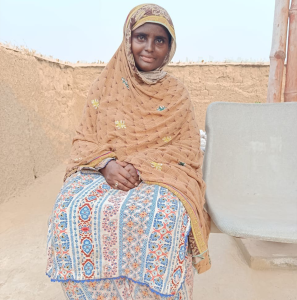 SHAMEEM’S QUIET JOURNEY TOWARDS HEALING
The Harsh Reality of Life at the Brick Kiln is Something SHAMEEM Knows All Too Well
Working at a brick kiln is tough, and one example of this hardship is the life of Shameem. Herself and her husband work long hours just to make the ends meet, all while raising their 6-years-old son and carrying the silent grief of two miscarriages.
When fever and severe arthritis made daily work unbearable,
“Shameem came to our health center, unable to afford medicine and unable to take time off, as the kiln owners do not allow long absences.”
She brought her hospital reports, and after reviewing them, we provided her with a full month’s supply of the medicines she had been prescribed, free of cost. A month later, she returned with new test results and a hopeful smile. Her reports showed significant improvement.
Today, Shameem walks from the kiln to our center for her follow-ups, grateful and relieved. She works and moves through her days with strength. Her quiet prayers and gratitude remind us how even small acts of support can restore dignity, health, and hope.
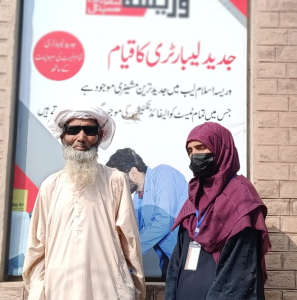 PAHCHAAN HELPED BABA ALLAH DIN SEE AGAIN
For Years, The World Around Baba Had Been Slipping Into A Blur
At 70, living alone since the early loss of his wife, he quietly visited our center for medicines carrying a loneliness only life can teach. When our team checked on him, Baba finally shared the pain he had been hiding. His vision had become so weak that even recognizing faces was difficult.
“بیٹا، اب تو چہرے بھی دھندلے نظر آتے ہیں۔”
An eye specialist confirmed سفید موتیا (cataract) and recommended immediate surgery. Baba’s heart sank. He lowered his voice and said, “Meary pas na ilaaj k paisay hai na Safar k. Main kaha jaun?”
For him, it was not just an illness, it was helplessness.
Our team assured him that he would not face this alone. We guided him to the Wareesa Islam Trust Hospital offering free cataract surgeries. PAHCHAAN approved full support for his medicines and travel, and a community mobilizer accompanied him to every visit, ensuring he never felt lost.
The surgery was successful.
When Baba opened his eyes afterward, a soft smile spread across his face full of relief and hope. For the first time in a long while he could finally see clearly. Holding our team member’s hands, he said: “Allah ap sub ko khush rakhay, Aj mujhay lagta hai zindagi wapis agai hai.”
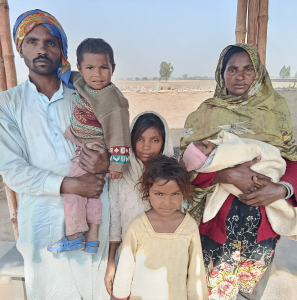 WHEN ONLY A FEW DOLLARS SAVED TWO LIVES
With only $17, two precious lives were restored.
Who knew that a handful of capsules and a few drips could mean the difference between life and death?
Sonia was two months pregnant when she arrived at the center. Her hemoglobin was 6 g/Dl, far below the normal 11-12 g/dL. Two heartbeats were at risk. Not because she chose danger, but because she could not afford the treatment that could save them both.
Severe anemia during pregnancy is more than weakness. It brings complications, threatens delivery, and can snatch away both mother and child. For Sonia, poverty made this invisible threat all too real.
Yet, with medications, two drips, and regular follow-ups, Sonia slowly reclaimed her strength. Her hemoglobin rose steadily to 8.9 g/dL. On 25 October, Sonia held a healthy baby boy in her arms.
For most of us, the cost of her treatment is pocket change. For Sonia, it was the difference between despair and hope. A few dollars saved two lives, and gave a family a chance to dream again.
The story of Sonia is not unique, it is the reality for hundreds of mothers. And it is your generosity that writes a different ending.
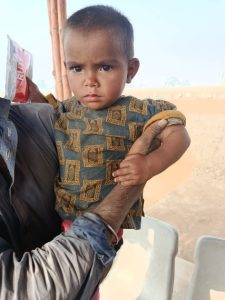 2 Years Old, Malnourished … Fighting for Life
Before she could speak in full sentences, her body had already begun to give up. This is the story of how hunger almost took a life and how timely care brought it back.
It’s so hard to watch a child fading before our eyes and not being able to do anything. It broke our heart to see life slipping away from someone who should be laughing, running, and exploring the world.
A two-year-old girl named Maria arrived at our center with her mother, suffering from severe malnutrition. She weighed only 5 kg and MUAC was below average too. Her tiny arms and fragile legs spoke of hunger, weakness, and months stolen by malnutrition. We provided her with free of cost Ready-to-Use Therapeutic Food (RUTF) daily, until her health was restored.
Each bag, costing just half a dollar, carried all the essential nutrients Maria’s growing body desperately needed – something poverty had denied her.
In just two months, a few hundred dollars changed everything. Maria began to smile, explore, and play with the energy every child deserves. Her weight climbed to a healthy 8 kg, and her MUAC improved to 13 cm.
Maria is not alone. Countless children, wasted by malnutrition, can be saved with just a few hundred dollars. Maria’s story is a powerful reminder that even the smallest act of generosity can become the biggest lifeline for children in rural communities.
Every bite, every step, every rupee counted.
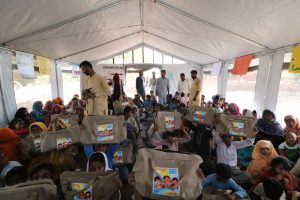 Jhang Visit
Date: 25 September, 2025
South Punjab’s Flood‑Stricken Communities Receive a Lifeline of Care from PAHCHAAN
In September 2025, PAHCHAAN’s team visited the flood-affected villages of Jhang, Rajanpur, Multan, and Muzaffargarh, where ruined fields, collapsed homes, broken roads, and the loss of livestock had forced families into makeshift camps or to survive under the open sky. Surrounded by stagnant water and poor sanitation, communities were left not only struggling for basic needs but also traumatized by the loss of livelihoods. Children were distressed, while parents carried the heavy burden of fear and uncertainty.
Responding to this humanitarian emergency, PAHCHAAN’s response team set up Mental Health and Psychosocial Support Stations (MHPSS) to provide counseling to children and parents, raising flood‑crisis awareness, and distributed MHPSS kits, including games, stationery, and coloring materials, to create safe, therapeutic spaces for children.
These interventions are not merely distractions; they are essential tools for rebuilding resilience. Through safe spaces, professional counseling, and practical support, PAHCHAAN is helping flood-affected communities heal and rebuild hope for a more stable future beyond the floodwaters.
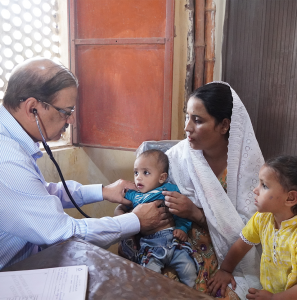 A QUESTION NO ONE ASKED, UNTIL ZEBA DID
It is the small voices that often spark the biggest change.
Everyday women arrive at our Mother and Child Health Promotion Centre in Chak 59. Some are in a hurry, carrying their children bundled in blankets; others come quietly, hearts heavy with worries no one else hears. And then there was Zeba.
Zeba was 25, a young mother of four. That day, she came for the checkup of her children’s coughs and fevers. But as she prepared to leave, Zeba paused. Her words came in whispers, almost lost in the bustle of the center, yet to us, they rang louder: “Can I… ask about family planning?” It was a bold question carrying the weight of countless women in communities too often unheard.
We encouraged her openness, offering confidential counseling. Every option was discussed, every fear acknowledged. In the end, Zeba received a family planning injection, and encouragement for monthly follow-ups.
For us at Chak 59, Zeba was not just the first woman but also the first woman person ask what so many others silently feared. The first whose small question rippled outwards, carrying hope, change, and empowerment. She came for her children’s ailments, worried and humble, but she left as a beacon, quietly promising to share her courage with others.
This is how, through your contributions, revolutions at our center often begin, not with proclamations, but with whispers.
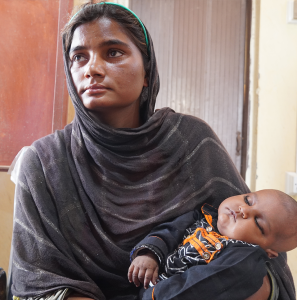 $3 is All It Takes to save a Lineage
In Pakistan’s underserved communities, parenthood is an act of love practiced in the dark. One worried mother wraps her feverish child in layers of wool, believing warmth is protection.
Another carries her newborn to a peer baba, spending thousands, returning with cuts etched into a baby’s belly.
Will any mother ever wish to see her child’s skin opened by a blade? Or watch her little one burn with fever, risking serious complications, or lasting brain damage?
The tragedy was never in their hearts. It was in the absence of guidance.
Absence of a single, simple consultation. A consultation is given totally free of cost to thousands of mothers that reach our center every year.
This is what our Mother and Child Health Promotion Centers are delivering across Punjab’s underserved communities. We do not merely treat illness, we prevent tragedy before it begins. Our interventions today ripple into tomorrow. It shapes the next generation, protecting lineages before tragedy can touch them.
Your contribution creates an impact that cannot be measured in money alone. It is the chance to educate a mother so that no child ever has to endure preventable suffering.
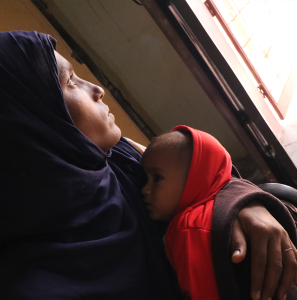 Faith and Healing
ایک مقامی بابا نے اسے بتایا کہ بچے کے لیے چاندی کے ورق کو پانی میں گھول کر پلایا جائے۔
Belief was never the problem. Understanding was.
After losing two of her children, Asma became deeply conscious about the wellbeing of her youngest daughter, Muskaan. Determined to protect her, she sought every possible way to ensure her child’s health and safety.
She had relied on a local baba, who had advised traditional practices. But her heart was not satisfied, and she sought further help from the Chak-59 MCHPC, seeking professional care.
At the centre, PAHCHAAN’s community mobiliser counselled her with patience and empathy, explaining that faith and medical treatment could go hand in hand. Using prescribed medicine did not contradict belief; it safeguarded what God had entrusted.
Asma listened intently and learned to trust science instead of superstition. Accompanied by her nephews Sahil, Ali Raza, and Omar she witnessed firsthand the struggles of families in her community, highlighting the critical need for PAHCHAAN’s outreach.
She continued to visit the centre regularly for guidance, check-ups, and counselling. Each visit strengthened her understanding that awareness, early care, and timely medical attention could save lives, giving Muskaan the future her two sons could tragically never have.
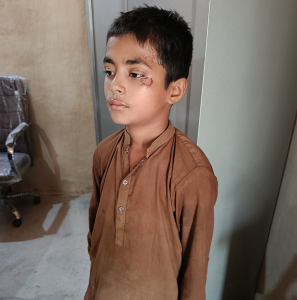 WHEN IT’S A CHILD’S EYE AT RISK… DO FALSE BELIEFS STILL MATTER?
Deep-rooted misconceptions often delay care until the risk becomes unavoidable. This is one such moment.
Abid is only 10 years old. He belongs to a family that never stepped inside a health center, not because they didn’t need help, not because they didn’t care, but because they were trapped in a belief echoed across their community:
“Yeh dawaein maghribi hain… yeh hamare liye nahi banin. Yeh hamare logon ko nuksaan pohanchati hain.”
Medicine is medicine. It has no nationality, no politics, it has one purpose; to heal. When blood flowed near Abid’s eye and his cries filled the room, Bushra’s fear changed. At that moment, she wasn’t afraid of medicine, she didn’t think of ‘Western’ or ‘foreign,’ she was afraid of losing her child’s eyesight.
Bushra ran to our center. Our team treated Abid’s injury with care. Alongside healing his wound, we counselled Bushra. We listened without trying to force a change in her mindset. Instead, we shared the truth and allowed her to see for herself what choice was best for her child.
That day, it was not just Abid’s wound that was treated, it was Bushra’s misconception that medicine could be dangerous.
This is the power of counselling we believe in and it is provided at all our centers. By sitting with families, hearing their beliefs we plant seeds of understanding.
By educating one mother today, we protect the future, the next generation. We uplift entire communities so that no mother fears mediction, and so that no false belief becomes a barrier to saving what is most precious to them.
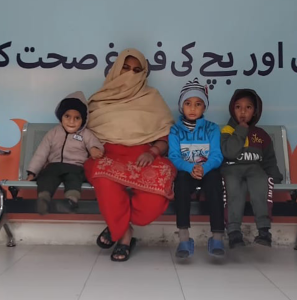 BECAUSE EVERY FAMILY DESERVES DIGNITY IN HEALTHCARE
At PAHCHAAN, all our centers work closely with nearby hospitals, acting as vital linkages to tertiary care facilities and helping communities reshape their thinking toward healthcare. Too often, we see patients coming to us only when their illness has already pushed them to the edge. When we ask why they hesitated to seek hospital care earlier, they share a painful truth: they often feel disregarded because of their financial condition, and their concerns are not taken seriously.
This is exactly why we built this institution. Our teams have worked diligently to develop trusted connections with nearby hospitals so that families can receive timely care, respectful treatment, and proper guidance. These partnerships are at the heart of our success in strengthening communities and ensuring that the locals receive the healthcare they deserve.
It is not only Rimsha who found hope through our support, but many mothers, fathers, and children have reached recovery because timely referral saved their lives. Through these linkages, they are not just treated medically; they are heard, respected, and cared for with dignity and compassion.
We envision every community having its own PAHCHAAN, a place where families are guided, mothers are empowered, children are protected, and healthcare reaches them before crisis does. When access is timely and treatment compassionate, generations grow stronger and healthier. No mother should ever face loss simply because support did not arrive in time.
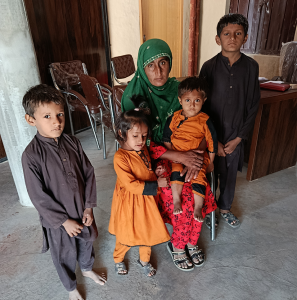 “I KNEW IT WAS FAR, BUT I HAD TO TAKE MY FAMILY”
For a father, no distance is too far when a child’s life is at stake.
16 kilometers. That’s the distance Latif walked with his wife and children, carrying not just their belongings but months of worry and pain. His children were suffering from scabies, their small bodies covered in painful sores and abscesses.
“I knew the center was far,” Latif remembers, “but I couldn’t let my children suffer any longer. I had to take them there.”
Arriving at the PAHCHAAN health center brought more than treatment; it brought understanding. The team didn’t just provide medicines; they explained simple, practical ways to care for his family at home. How to maintain hygiene, wash bedding properly, and keep the children clean. Latif listened carefully, followed every instruction, and for the first time in months, he began to see change. By the second visit, the children were healing. By the third, they had fully recovered. Relief washed over him like a long-awaited rain.
Sanawan is a small village where decisions are often guided by lived experience rather than need. Although health facilities exist nearby, Latif chose to travel 16 kilometers to reach the PAHCHAAN center after a friend spoke of the care and guidance his own family had received there. It wasn’t the distance that mattered, but the trust built through shared experiences that made the long journey feel worthwhile.
It is this trust that inspires PAHCHAAN’s vision: a health center every 20 kilometers, so that no family has to walk long roads in search of basic care.
*To clarify the readers in Lahore, 16 kilometers is almost like the distance from Railway station to Thoker Niazbaig. That’s how far Latif traveled with his family, on foot, just to ensure his children received proper care.